blog

what role for obama’s atrocities prevention board?

Yesterday, I had the privilege to participate in the White House’s unveiling of the Obama administration’s Atrocities Prevention Board, an interagency policy mechanism for mass atrocities prevention. The Board is a long-awaited policy achievement for the atrocities prevention community, dating back to the Genocide Prevention Task Force’s 2008 call for U.S. policymaking leadership on genocide and mass atrocities. The Board’s creation headlined the day’s events; however, the administration took the opportunity to unveil a melange of human rights-related policies, including restrictions on atrocities-enabling technology companies, an extended mandate for U.S. military advisers operating in LRA-affected areas, and a first-ever National Intelligence Estimate on mass atrocities risk. Many of the policy proposals appeared wonky and uninteresting, if essential (woo, strategic planning!); others, such as USAID’s innovation grants partnership with Humanity United, demonstrate potential areas for public/private/social sector collaboration on atrocities prevention.

I was fortunate enough to participate on a panel at the unveiling, focusing on grassroots mobilization and the future for atrocities prevention policy. I centered my commentary on “disruptive” approaches to human rights advocacy–that is, crafting grassroots opportunities for new policy narratives, new constituencies, and new strategic partnerships. I gave a brief plug for STAND’s work on diaspora outreach, as well as our nascent forays into civil society outreach in emerging societies and democratizing states. Additionally, I discussed STAND’s evolving theory of change, which I’ve explained on this blog: as I put it, “[i]n twenty years, the effectiveness of our advocacy will not rely on the number of bills we pass, but on the number of our fellow advocates on the Atrocities Prevention Boards of future administrations.” Over the long-term, moral, compassionate participation in U.S. foreign policy decision-making matters, and should remain a priority for grassroots constituencies. You can find a brief summary of my talking points at PolicyMic, where I published a piece yesterday morning. (Also, in the video above, I start speaking at 22:10, or so.)

To its credit, the White House facilitated the active participation of online and offline constituencies throughout the day’s events. Advocates, practitioners, and academics of all stripes offered their two-cents, noting the opportunities and shortcomings associated with the Atrocities Prevention Board’s implementation. For many, the administration’s symbolic chutzpah was too much to handle: at the event, as well as online, Sudan advocates observed the disparity between President Obama’s “Never Again” pledge and the persistence of mass atrocities in Sudan. Syria, too, represents a challenging factor on the policy radar. I remain skeptical of the United States’ continued influence in both circumstances, but atrocities’ ever-present stain on the human conscience raises a critical question: How do U.S. policymakers and human rights advocates balance the implementation of immediate and structural priorities? And, more topically, how can we envision a role for the Atrocities Prevention Board in bridging this seemingly irreconcilable gap?

First, let’s start with the Board’s composition. The Board is a manifestation of the sum of its parts, which may strengthen or hinder the Board’s initial work. As with all interagency bureaucracies, individual leadership, trust, and reliability determines the effectiveness of political decision-making. Judging from Power’s presentation of the Atrocities Prevention Board, the new body is a mixed bag. The State Department and USAID representatives–human-security champion Maria Otero and Don Steinberg, respectively–are both high-level, credible officials, with extensive backgrounds in atrocities prevention work, and high levels of credibility within their individual agencies. Otero is, unfortunately, the only woman on the board, but I was pleased to see her take a commanding role in the subsequent discussion–she has Clinton’s ear, and appears willing to use her credibility to push the atrocities prevention agenda forward. On a related note, the Treasury Office of Foreign Assets Control’s Adam Szubin has an extensive, cross-issue background in sanctions implementation; the administration’s expansion of “smart sanctions” to confront Syria, Sudan, and similar regimes will emanate from Szubin’s office.

Next, what will the Board do, and how can we establish standards for success? Judging from the Twitter discussion, a widespread misperception of the Atrocities Prevention Board’s political purpose abounds. The Board can do little to “stop atrocities”; as human rights advocates, policymakers, and scholars have observed, atrocities escalation is a steep slope, and the opportunities for external policy intervention are, in fact, limited. As an interagency body, the Board’s contributions to full-scale atrocities and rapidly escalating conflicts will be limited–as Princeton Lyman observed during his comments, the Sudan policymaking process will continue, with or without the Board’s stamp of approval. There are wheels in motion, so to speak, and the Board’s convening, coordinating, and information-sharing authorities can do little to shift the strategic, political, and intra-organizational dynamics of the moving policy process. As Otero discussed in her comments, you won’t see the Board pushing for the ratification of the ICC’s Rome Statute, or proposing a no-fly zone over South Kordofan (thank goodness), or encouraging the deployment of military advisers to Uganda. Throughout his USHMM speech, President Obama highlighted a variety of policy decisions, but don’t take that as an indication that the Board will play a role in the policymaking process, strictly defined.

As the administration’s fact sheet makes clear, the Board’s real value-added stems from its bureaucratic capabilities, ones which appear irrelevant to the unassuming eye. The Atrocities Prevention Board will encourage the training of diplomats, development practitioners, military officials, and intelligence officers in atrocities prevention strategies; facilitate cross-national trainings of foreign militaries, law enforcement, and peacebuilding authorities; and, where relevant, provide greater support to the distribution and identification of early warning and atrocities risk. The bureaucratic mechanisms within which these processes will operate are unclear–the Board will not receive a dedicated staff, and there was little honest discussion of Congressional cooperation on and support for the administration’s new initiatives. In “responsibility to protect” terms, the Board is a second-pillar initiative, intended to build national capacity, craft training-based partnerships with national governments and local institutions, and strengthen the tools, intra-organizational will, and policy mechanisms through which atrocities are prevented. The institutionalization of atrocities prevention does not refer to the normalization of humanitarian intervention; rather, the Board will encourage the long-term diffusion of human security norms throughout foreign policy institutions.

yom hashoah: how mass atrocities end

Today is Yom HaShoah; for my non-Tribal readership, Holocaust Remembrance Day. For global Jewry, Yom HaShoah is a day of mourning, to reflect on the deaths of 5.7 million Jews during the Second World War. In true form, Holocaust Remembrance Day is also a day of communal resilience, inspired by the splendor of a still-vibrant Jewish culture, history, and people, sixty-seven years after its impending destruction. As Jewish life in the United States has become increasingly secularized, Yom HaShoah’s resilience theme has adopted a universal tone. Holocaust Remembrance Day has shifted towards Genocide Prevention Month, applying the moral lessons of the Holocaust to past genocides, future atrocities, and the collective challenge of confronting them.

As I’ve discussed before, the past three decades of public Holocaust memory, commemoration, and remembrance have created an unwavering morality of atrocities response, manifested in the present-day atrocities prevention movement’s ethical posture. However, the texture of Holocaust discourse has transformed. Millennials are two generations removed from the waning community of Holocaust survivors, and compelling stories of humanity’s moral failures are more likely to emerge from former child soldiers in Uganda, youth activists in Bosnia, and genocide survivors in Rwanda. Compare, for example, two liberal-interventionist-minded pieces: the first, by the late Tony Judt, calling for the deployment of a large-scale force to halt atrocities in Kosovo; the second, by Marc Lynch, calling for the implementation of a no-fly zone in Libya. Writing in 1999, Judt draws the often-used comparison between Hitler’s genocidal violence against Central and Eastern European Jewry and Slobodan Milosevic’s atrocities in Kosovo. In Lynch’s moral plea, meanwhile, Hitler is nowhere to be found–the Bosnia/Rwanda/Kosovo comparison, instead, is Lynch’s defining clause. There is a sense that, post-Godwin’s Law, Holocaust comparisons are off-limits, packed away in a moral chart of humanity’s worst atrocities.

Perceptions of the Holocaust’s uniqueness are not confined to the ethical realm–the field of political science and empirical observation, too, spends little time questioning, considering, and probing the institutions, incentives, and organizational characteristics of the Nazi genocide. Jay Ulfelder and Ben Valentino’s atrocities dataset (ungated)–as far as I can tell, the more comprehensive quantitative reckoning with mass atrocities–starts with political repression in postwar Eastern Europe, omitting the varied atrocities against Jewish populations in the “bloodlands” and Central Europe. From a quantitative perspective, the omission of the Holocaust makes sense: as a historical event, the Third Reich’s atrocities are difficult to disaggregate; the dynamics of local, regional, national, and international politics arguably shift during the post-1945 period, due to “revolutions” in international institutions, military affairs, global polarity, and the politics of ideological action; and, frankly, you have to start somewhere, and the aftermath of an unfathomable atrocity is as good as any.

But, from a qualitative perspective, the Holocaust may yield a more instructive guide to atrocities termination than we usually consider. Crafting a case study on atrocities termination and the Holocaust is nigh impossible–with few exceptions, more literature has been published on the Holocaust, Nazi Germany, and the Second World War than any other subject, and the Nazi genocide is more accurately described as a aggregation of infinite cases. At the same time, in an effort to remove the pale of abstraction from our policy understanding of the Holocaust, here are a couple of conclusions on atrocities termination, atrocities intelligence, and Holocaust memory:

Technology is important, but atrocities result from the mobilization of human institutions: In describing the Rwandan genocide, Jeffrey Herbst differentiates between the mass mobilization of Hutu genocidaires, and the Holocaust’s “industrial process” of mass killing. However, as Timothy Snyder has observed in his remarkable revisionist history of mass killing during the Second World War, the Holocaust was both a technological, industrial atrocity and a counter-technological one. That is, death-by-bullets played an equally prominent role in the near-extermination of Eastern European Jewry as did Auschwitz, Treblinka, Sobibor, Majdanek, Chelmno, and Belzec death camps. In six months, between June 1941 and the end of the same year, German Einsatzgruppen, Romanian militias, and local paramilitary forces killed over one million Jews–as Snyder observes, the same quantity as had perished in Auschwitz throughout the war. Human institutions–the Einsatzgruppen, low-level Nazi leadership, local Quislings–defined the Holocaust’s implementation throughout the former Pale of Settlements, in addition to the more-frequently-cited industrial infrastructure of genocide.

Assessing capability and intent is challenging, even after-the-fact: Throughout the past three decades, few historiographical debates have transfixed the Holocaust research community more than the functionalist/intentionalist divide: when did the Nazi regime plan the Holocaust, and why? As with most historiographical debates, the consensus has fallen somewhere in the middle–the “Final Solution,” which began in 1942, was a planned characteristic of the Nazi ideology, but would not have existed in the absence of the Second World War, the political threats and opportunities associated with Operation Barbarossa, and the internal politics of Nazi rule. If historians remain divided in their retrospective assessment of Nazi intentions, one can imagine the challenge of strategic analysis during the atrocity, particularly given the paucity of the U.S. and British intelligence communities during the Second World War. Intelligence existed–particularly through Jan Karski and his compatriots in the Polish government-in-exile–but the scope, scale, and future trajectory of the Nazi genocide remained unclear. As Andrew Exum recently observed, the absence of certainty, combined with existing biases, perceptions, and organizational inertia, poses a distinct challenge for the policymaking process. Strategic uncertainty surrounding atrocities intelligence–an unavoidable characteristic of policymaking institutions–may manifest itself as moral failure, as in the case of the Holocaust.

Moral questions aside, external intervention’s effectiveness is rarely clear: Fueled by David Wyman’s historical work on U.S. responses to the Holocaust, a lively discussion has persisted on the counterfactual effectiveness, moral appropriateness, and historical value of “bombing Auschwitz.” As the David Wyman Institute has demonstrated, a broad base of Jewish organizations, including global leadership of the Zionist movement, supported the deployment of U.S. force to halt operations as Auschwitz-Birkenau. Throughout the postwar period, Auschwitz intervention advocates pointed to the release of reconnaissance imagery as an indication of U.S. capacity–and unwillingness–to bomb the Nazi extermination facilities. However, as Richard Levy has controversially observed, the operational and command dynamics of prospective U.S. Auschwitz bombings remained opaque. When considered in the context of Operation Reinhard and the continued perpetration of atrocities against Jewish populations throughout Eastern Europe, the utility of external military intervention–outside the context of the U.S. conflict against Nazi Germany–is not readily apparent.

ending mass atrocities: five-and-a-half lessons from jeff winger

If you didn’t watch Community‘s latest episode–or, worse, didn’t enjoy it–you’re missing something. Between the Ken Burns effect, the raw sound editing, and the cinematography, the episode was a visual masterpiece; add in the usual banter, and you have twenty-one minutes of Paintball-level quality. In addition to the episode’s cinematic value, the Pillows and Blankets motif functioned as an instructive manual for conflict resolution and atrocities termination practitioners. Here’s a brief guide, courtesy of Jeff Winger:

1. Local conflicts are often internationalized, and international conflicts are often localized: At its core, the Pillowtown/Blanketsburg civil war is a localized land conflict, characterized by short, brutal squabbles over small classrooms, former common areas, and stretches of hallway. Its root causes lay in the contested, yet transient identity conflicts between politicized Pillow advocates and Blanket enthusiasts. At the same time, Greendale’s ethnicized conflict is reliant on an international structure of political, economic, and social incentives. The Dean’s obsession with the Guinness record appears to be a sideshow, a system of political objectives imposed by meddling, predatory third parties. However, as the episode’s conclusion indicates, the international element of civil conflict was relevant to individual and collective motives for violence. Elites–Troy and Abed–continue to squabble, but their ability to mobilize civilian communities was highly dependent on the international political economy of warfare.

Political scientists have attempted to explain the ways in which local and international economies of violence operate, with recent works emphasizing the role of local violence in fueling long-standing, intractable patterns of mass atrocity. Indeed, basic conclusions from quantitative datasets indicate that even as international power dynamics shift, local conflict drivers may manifest themselves in conflict duration, onset, and severity. However, local political actors, conflict entrepreneurs, and opposition movements are keenly aware of the international dimension of intrastate war, often exploiting international social networks for political benefit. As in the Greendale civil war, neither the local nor the international dimension of civil war is an expendable element of conflict resolution and atrocities termination policy.

2. Asymmetric intelligence kills: In the Greendale civil war, the worst atrocity events are not caused by the willful deployment of a murderous, industrial infrastructure; rather, they are the result of significant intelligence failures. Philippe Silberzahn, from SCIP.Insight, captures the problem well: policymakers suffer from gaps in intelligence analysis, rather than collection. Greendale’s military operatives have access to broad sources of operational and strategic intelligence–Troy and Abed deploy diverse collection disciplines, including signals and human intelligence, to gauge the opponent’s military actions and political decision-making. However, analytic assumptions and biases cloud the respective military leaders’ understanding of opposing capacities, with perilous consequences for Greendale’s civilians. In contrast to the destructive, overpowering “juggernaut” Troy assesses, Abed’s Pierce-controlled, Michelin Man-like puff-monster is a weapon of limited effectiveness, as demonstrated by its non-decisive, fallible role in the Battle of Greendale. However, assuming a more powerful arsenal, Troy deploys the Changlorious Basterds, a rag-tag, pubescent group of blood-thirsty mercenaries. Troy’s mercenaries wreak havok on Pillowtown, destroying civilian pillow-structure, cutting off essential supply chains, and disrupting the state’s massage-circle-based, communitarian economy.

3. Decisive victory is often an insufficient approach to atrocities termination: The interaction between operational goals and strategic objectives is a crucial prerequisite to an understanding of decisive victory’s potential role in atrocities termination. Political objectives underline their military counterparts–in Clausewitzian form, military force is subordinate to policy. As discussed above, the Pillows and Blankets war has its origins in Troy and Abed’s parallel political objectives: the assertion of territorial control over Greendale’s indoor campus building. Force is instrumental, as are the mass atrocities associated with its use. In the Greendale civil war, force operates at the operational level, intended to strike at Troy and Abed’s centers of gravity–the resilience of the erstwhile-friends’ respective infrastructures and civilian populations.

Before the Guinness withdrawal, Troy appears to hold the upper hand, with the Changlorious mercenaries pummeling Abed’s fluffy juggernaut. However, even if the mercenaries and Blanketsburgian troops reigned victorious, atrocities would likely have continued, with Blanketsburgs’ civilians initiating reprisal violence against their Pillowtownian adversaries. The consequences of the shortest, most seemingly inconsequential atrocities can, in fact, have wide-reaching consequences, due to persistent perceptions of antagonism between Pillowtownian and Blanketsburgian civilians. Decisive victory may eliminate the short-term political incentives for atrocity mobilization, but over the long-term political, economic, and social foundations for conflict onset remain.

4. Unfortunately, so are negotiated settlements: Jeff and the Dean’s first negotiation round is a classic demonstration of a political “commitment dilemma,” an essential hazard of third-party policy intervention in intrastate wars. In contrast to the second round of negotiations (see point 5), external actors perceive few incentives for credible participation in multi-party negotiations, as demonstrated by the Dean’s half-hearted plea for Jeff’s mediation, as well as Jeff’s persistent cynicism. In the context of the first round, the lack of strategic consequences, instability spillovers, and human tolls create a non-permissive environment for preventive diplomacy. With few incentives for participation, Jeff and the Dean create a diplomatic space for status quo mediations, based on an unsustainable ceasefire, rather than inclusive, transformative mediation between Pillowtown and Blanketsburg.

Jeff’s settlement provides amnesty for political elites, with no punitive measures to coerce a mutual peace. Almost instantly, the negotiations fall apart, with Troy and Abed returning to solidify their divisions, stake out separate territories, and escalate atrocities against opposing civilian populations (Troy’s “all tomato” to Abed–easily the episode’s best pun).

5. Political elites respond to the darndest things: In his second round of negotiated talks, Jeff attempts to coerce Abed and Troy towards peace, providing them with dusted-off, imaginary “friendship hats,” which symbolize the restoration of long-standing, ultimately unshakeable camaraderie. Innovative conflict resolution strategies are frequent characteristics of civil war termination; indeed, the best approaches respond to unique contexts, allowing for flexibility, adaptability, and nuanced response. My favorite example: as late as 1994, Afonso Dhlakama, the leader of the guerrilla movement RENAMO, threatened to withdraw from Mozambique’s first post-conflict elections, damaging the country’s already-fragile political stability. In response, the international community sponsored a UN-controlled, $14.8 million trust fund for RENAMO’s elites, in order to provide personal incentives for political participation. As a short-term strategy, the trust fund worked, and Mozambique conducted the first of a succession of successful national elections.

5.5. No one likes Britta: ‘Nuff said.

does advocacy work? (part 2)

Editor’s Note: This is the second part of a two-part series on advocacy effectiveness and typologies of human rights mobilization. Check out the first part here.

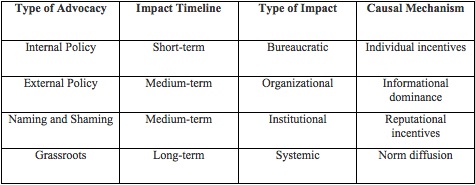
Internal Policy: “Bureaucracy” is a more concise, common title for “internal policy advocacy,” as the chart suggests. Bureaucratic decision-making is the most effective and frequent form of advocacy, for a variety of reasons. In contrast to external policy or “naming and shaming,” bureaucratic policy processes occur amongst people who have power, rather than between the powerful and the powerless. Additionally, internal policy advocacy yields resource distribution, political-will mobilization, and related, consequent results of the policy process. The impact of internal policy advocacy occurs in the short-term, resulting from a meeting, a memo, or a stroke of a pen. In general, bureaucratic processes take weeks, even months, to filter through the complex decision-making system; however, internal advocacy processes are instantly effective or ineffective, determined by an individual’s ability to persuade and coerce the collective institution.

As James Wilson observes in his essential work on the bureaucracy of public administration, dynamic, complex organizational cultures define the ways in which policy develops, managers interact with subordinates, and organizations prioritize individual perspectives. Within government bureaucracies, individual credibility, relationships, and incentives for decision-making determine the impact and effectiveness of the advocacy process. Advocacy effectiveness is a human process, determined by the strength of human relationships: If a State Department Policy Planning staff member falls out of favor with the Policy Planning director, there are few incentives for the staff member’s particular policy to materialize, beyond its inherent value.

External Policy: External policy advocacy occurs between advocacy elites and policymaking officials. If the intelligence community provides a constant stream of non-policy expertise, external advocates provide the policy counterpoint. The U.S. civil service is a peculiar beast: with the exception of the Pentagon, the Central Intelligence Agency, and a couple of other government bodies, most government employees receive relatively few years of professional and leadership development training, particularly in comparison to counterparts in the British Commonwealth. Civilian responsibilities are increasingly outsourced to contractors in the private sector, many of whom are embedded in government offices. With the exception of a few, uniquely technocratic offices (Special Envoy to Sudan Princeton Lyman’s office is one), policy-makers and government institutions rely on a broad base of external support to craft policy, direct the flow of information, and, in the case of the legislative branch, develop legislation. Most Congressional staffers have neither the time nor the interest in directing legislative development process on foreign policy issues beyond Iraq, Afghanistan, Iran, and a small set of counterterrorism and proliferation issues. Accordingly, external policy advocates play a decisive role in identifying what gets to the table, how it’s delivered, and how Congressional officials and policy-makers can amplify its importance.

In contrast to internal processes, the effectiveness of external policy advocacy operates over the medium-term. There are, of course, human elements: who has the Hill contacts in which office, who gets a meeting with an envoy or an ambassador, and which reports policymakers read. The development of organizational credibility occurs gradually, and depends on an organization’s ability to demonstrate its comparative advantage in policy expertise and on-the-ground information resources. Standard operating procedures and security restraints frequently limit the reach of diplomats, intelligence officers, and other public information resources; external policy advocacy relies on the strength of information networks to bolster its effectiveness.

“Naming and Shaming”: In the interest of length, I’m going to link to two valuable resources on “naming and shaming,” causal mechanisms, and effective advocacy. Murdie and Davis, and Krain have both authored important quantitative analyses of human rights advocacy and “naming and shaming” strategies. I discussed the former yesterday; the latter addresses the impact of “naming and shaming” on the severity of genocides and politicides, finding an inverse relationship between “naming and shaming” efforts and atrocities severity. As the chart above indicates, and theoretical research confirms, “naming and shaming” impacts the reputations of atrocity regimes, as well as those of by-standing governments. However, according to Murdie and Davis’ excellent assessment, the presence of existing, on-the-ground political forces–civil society mobilization, political pressure–determines the institutional impact of “naming and shaming” strategies.

Grassroots: As I’ve discussed in previous, post-#KONY2012 pieces, our present-day understanding of grassroots international human rights advocacy is misguided. Consider the field: a broad spectrum of international human rights organizations operate in the United States, mobilizing local, regional, and national constituencies in support of a more compassionate, moral foreign policy. Give me a state, and I’ll name a respective network of activists for peace and human rights in Sudan. Add in the broad proliferation of diaspora organizations, social networks, and professional constituencies from conflict-affected states, and you’ll find hundreds of informal institutions advocating for a rights-based approach to U.S. global leadership. Suffice it to say that, in the midst of international political tumult, U.S. national security threats, and regional stability concerns in sub-Saharan Africa, Southeast Asia, and the Middle East, domestic human rights advocates have a hard time getting a foot in the door. Congress–the most direct entry-point for domestic advocates–may fund U.S. foreign policy ventures, but the executive branch defines the distribution of financial resources, human capital, and political attention.

In organizing strategy, as in military affairs, victory is the core element of successful mobilization, organization, and implementation. #KONY2012, popularly perceived as the pinnacle of grassroots mobilization, hasn’t changed that basic fact. Over the past month, political decision-making has not become more democratic, nor has social media empowered a greater role for activists in foreign policy mobilization. Grassroots actors–from “slacktivists,” to lobby-day participants, to community leaders–have been instrumental in the release and co-sponsorship of bipartisan LRA-related legislation; however, their impact has not been causal, strictly defined. Short-term impact by grassroots actors is endogenous to successful external policy advocacy; the development and encouragement of anti-LRA policy and legislation relies on advocacy elites, rather than popular mobilization. Grassroots advocates play a role, but their participation in external policy advocacy processes determines the success of political will-building initiatives.

More importantly, grassroots mobilization around international human rights impacts the long-term trajectory of U.S. foreign policy. The chart is misleading, leaving little space for dynamic interaction between varied forms of human rights advocacy. In reality, grassroots human rights advocacy affects the eventual diffusion of human rights norms within policy-making administrations. Effective grassroots advocacy is a civic practice, providing youth leadership with the opportunity to think about the world, engage in policy discourse, and prioritize a moral decision-making framework. If internal policy advocacy is the quickest, most effective mechanism for human rights mobilization, the goal of grassroots human rights advocacy must be to change that equation, as well as its quality, across generations, rather than within them.

does advocacy work? (part 1)

International Studies Quarterly‘s March issue includes an insightful article on advocacy effectiveness, human rights policy, and “naming and shaming.” The authors, Amanda Murdie and David Davis, assess a new dataset on advocacy effectiveness, noting the contextualized impact of “naming and shaming” practices by human rights organization, including Human Rights Watch and Amnesty International. Murdie and Davis’ findings are largely intuitive–mobilization works, so long as enabling conditions increase the target’s vulnerability. The authors provide an important assessment of the contextual foundations for impact-oriented human rights activity:

First, we introduce a new data set of HRO [human rights organization] naming and shaming by third-party actors that cite HROs. By doing so, we highlight the value of using events data to study non-state actors. This data set does not rely on the workings of one HRO but instead utilizes an existing events data framework to examine how multiple HROs are theoretically argued to shame, through international newspaper reports…

Our findings underscore the importance of the reputation mechanism through which improvements in human rights occur. We find that the effects of HRO shaming are not conditional on economic vulnerability; instead, HRO shaming works when either third parties join in efforts to pressure the state from abroad or when HROs are able to help increase domestic mobilization from within the state. These findings indicate that vulnerability to HRO shaming is not all materialistic in nature; states can be vulnerable to HRO shaming without high dependency on aid or foreign investment. We feel these findings support Risse and Sikkink’s (1999:6) contention that their theory is ‘‘generalizable across cases irrespective of cultural, political, or economic differences…’’

The empirical findings of this paper show that HROs can have an impact on human rights even without being able to enter a state domestically. This is important, as mentioned, because of the growing number of states that restrict operations of civil society within their borders. As shown above, we find that the majority of the conditional effect of HRO shaming comes ‘‘from above.’’

You can read the rest of the (ungated) paper here.

From a broader perspective, much of the comparative politics literature on transnational advocacy networks has centered on processes of sub-state political and social change, including norm diffusion within and between states, socialization opportunities, and tangible mechanisms for materialistic pressure. Finnemore and Sikkink, Carpenter, and Ron, Ramos, and Rodgers have demonstrated the effective role of transnational advocacy organizations in mobilizing political will, through sub-state agenda setting and political will-building. In contrast, blogosphere commentary has identified gaping holes in the effectiveness, impact, and utility of human rights advocacy–see, for example, a popular set of posts on “badvocacy” and the “Love Actually rule” of value-added activism. Beyond the unhelpful discussion on the comparative advantages of blogging and social-science research, the academia/blogosphere gap raises important questions about our definition of advocacy, our effectiveness metrics, and the ways in which we can better the various facets of the international human rights project.

International human rights advocacy is a diverse community, containing a broad, heterogeneous intersection of individuals, political actors, and organizations. Effective advocacy operates through a “theory of change“–that is, an understanding of the ways in which mobilization will change the world. The “theory of change” approach to advocacy mobilization relies on a core assumption of organizational and organizing theory: in order to achieve a goal, activists, actors, and community leaders need a strategic framework to ensure the effective distribution of institutional resources towards getting stuff done. Theories of change operate within political, social, and economic contexts, rather than in a vacuum. On the local level, theories of change are easy to identify: the chair of the Los Alamos Board of Regents relies on his Episcopal Church for political support, so encouraging the Church to endorse an environmentally responsible procurement policy may yield positive results. On the international level, theories of change are more complicated; pushing aside individual, bureaucratic, and inter-organizational dynamics, transnational advocacy networks operate in a complex, anarchic system, which is inherently anti-democratic, hierarchical, and non-transparent.

With varied, inconsistent theories of change in play, our perceptions of international human rights advocacy require a bit of disaggregation. In a recent post on typologies of political violence, Rachel Strohm used a chart display to outline the interaction between government and opposition mobilization categories. I found the visual compelling, and have tried to replicate the tactic below. I identify four types of international human rights advocacy (internal policy, external policy, “naming and shaming,” and grassroots mobilization), and create a framework through which these advocacy types impact the policymaking and foreign policy decision-making process.

Now that you’ve finished perusing my chart, check back tomorrow: I’ll feature explanations of the ways in which internal policy advocacy, external policy advocacy, “naming and shaming,” and grassroots mobilization influence the policymaking process. In the meantime, what do you think? If you’re a practitioner, does this mesh with your experience in the human rights advocacy field? If you’re a scholar, how does this advocacy typology stack up to your understanding of transnational advocacy networks and the foreign policy-making process?