civil liberties, hate speech, and mass violence

I don’t consider myself a civil libertarian, although that’s a perfectly fine–indeed, admirable–thing to be. On a basic level, I view collective security as the most desirable function of democratic governance; as Isaiah Berlin compellingly acknowledges, the collective security of a democracy’s citizens occurs at the expense of negative liberties. From Corey Robin’s perspective, the state’s growth has occurred in tandem with the mass repression of civil liberties. At the same time, governance tradeoffs exist, which test the strength of a democratic society, but which are also integral to the process of securing a state that protects its citizens. These tradeoffs are frequently false choices, both accidental and intentional: political actors may distort threats for nefarious purposes, but all too often, Berlin’s positive/negative liberty tension represents the unintended consequence of non-resilient policy organizations. Patrick Porter captures this shortcoming in a recent post: the hubristic assumption of preemptive authority mitigates our ability to struggle through crisis, and so policy institutions over-react. Over-reaction bloats policy institutions, which are slow to correct for their growth. As the proverbial crisis dust settles, prevailing institutional interests challenge bureaucratic complacency, leaving scarce space for adequately (small-l) libertarian approaches to policy-making. The ethical purpose of policy-making, therefore, is to optimize collective security and secure individual liberties, all the while acknowledging that it’s entirely impossible to do both.

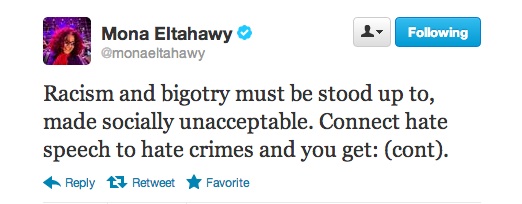
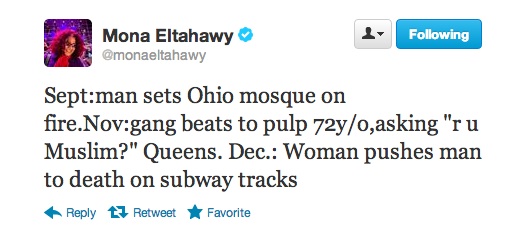
In some circumstances, the real-life dilemmas of collective security may seem realer than in others. The recent murder of Sunando Sen, an Indian-American Hindu, in a New York subway station is an important case in point. During her arrest, Erika Menendez, the woman responsible for Sen’s murder, condemned the victim’s religious background, lining her anti-Hindu rhetoric with anti-Muslim slurs. The Queens district attorney charged Menendez with two crimes: Sen’s murder and a “hate crime,” due to Menendez’s expressed motivation for violence. In the aftermath of the district attorney’s announcement, Twitter was a-twitter with idle speculation: given the subway context, had activist Pamela Geller‘s Islamophobic advertisements played a role in Menendez’s motivations? Egyptian-American journalist Mona Eltahawy, who prompted controversy for her public vandalism of Geller’s subway advertisements, drew an explicit connection between Geller’s “hate speech” and Menendez’s “hate crime”:
EltahawyEltahawy 2

While the district attorney’s office will not release the facts of the case while Menendez’s trial is ongoing, coverage of the subway-shoving incident has not indicated Geller’s particular influence in Menendez’s motivations. As Glenn Greenwald observed on Twitter, Pamela Geller represents a singular sub-set of American Islamophobia. While we may discern cultures of violence and Islamophobia that, generally speaking, enable hate-inspired murders, existing evidence does not render Geller’s propaganda more or less influential in Menendez’s motivations. Accordingly, we can differentiate between “hate speech,” which implies a particular act, and “hate culture,” which describes a general environment of social exclusivity and marginalization. Insofar as Menendez’s Islamophobic has occurred in a context, rather than as a consequence of bigotry, the driver (not the cause) of Sen’s murder was “hate culture.”

As I noted on Twitter, this distinction is not semantic, but profoundly relevant to our civic and social approaches to hate-inspired violence. The problem with hate-inspired murder is that one person kills another person, not that they’re also hating the other person’s communal affiliations while doing so. If we view the state outside of its Weberian framework–a monopoly on legitimate violence–and instead as a social institution with unique, if not totalizing access to coercive force, it’s easy to see where a “hate speech/hate crime” approach to inter-communal violence might fall short of the state’s ethical responsibilities to its citizens. Simply put, if the state’s power exists on an even keel with its civil society, its concept of inclusivity should equal all others’. David Cole’s analysis of “hate speech” legislation identifies its libertarian consequences more articulately than I can:

Such laws empower the government, or a jury, to draw lines between legitimate criticism, satire, and public comment on the one hand, and “insulting,” “abusive,” or “hateful” speech on the other. Is there any reason to be confident that government officials or juries will do a good job of this? And as long as the lines are so murky, many people will be compelled to steer clear of legitimate expression that some official or jury might, from its own viewpoint, deem over the line after the fact: this would stifle free speech and lead to self-censorship.

This assessment isn’t new: in fact, it’s standard fare for your ACLU-card-carrying, speech-loving, civil libertarian activist. There’s little dissent on the importance of free speech in a democratic society. More controversial, of course, is the speech’s consequences for mass violence. Susan Benesch, who I’ve mentioned before, differentiates between “hate speech” and “dangerous speech,” a distinction she developed out of an interest in protecting both freedom of expression and collective security. Benesch’s “dangerous speech” is highly context dependent. Compared to Burma, where mass violence against Muslims occurs on a regular basis, American Islamophobia yields infrequent violence because of the strength of U.S. security institutions and the rule of law. As Benesch acknowledges, hate crime legislation, when understood independent of institutional factors, does little to mitigate mass violence against vulnerable minorities, but goes a long way to restricting their libertarian rights.

mitigating small arms flows: thematic lessons from the international scene

Last Friday’s shooting at Sandy Hook Elementary School, in Newtown, CT, has sparked a recognizable groundswell of public support for renewed gun violence prevention efforts. This process should be familiar to atrocity prevention advocates who, in the aftermath of mass violence in Rwanda, Syria, or Sudan, look to the mantra of “never again” as a source of moral urgency. In Sandy Hook’s wake, both gun safety, historically a priority for the National Rifle Association and affiliated “pro-gun” groups, and gun control have returned to the fore of the public agenda. As Sarah Kendzior has observed, calls for a “national conversation” about gun violence, cultures of violence, and mental health abound.

Since Sandy Hook, gun control advocates have informed the national gun control conversation through comparative perspective: the United States possesses more firearms than any other country in our income bracket, and more firearms per capita than the rest of the world, including a smattering of active war zones. Austria and Australia‘s violence prevention case studies have circulated widely, as advocates assess the institutional, legal, and social prerequisites for mitigating gun violence. These case studies are theoretically useful–comparable levels of economic development, institutional strength, and criminal violence should yield comparable conclusions on gun violence prevention. Beyond the two case studies, however, empirical indicators of gun violence reduction are surprisingly scant.

In the context of our comparative lens, the national conversation on gun violence is asking the wrong questions. Rather than viewing U.S. firearms policy through the narrow lens of gun control and access, U.S. commentators should frame gun violence as a question of domestic and transnational small arms flows. The Second Amendment and its cultural importance reframe the public conversation: nowhere else, and particularly not in post-conflict environments, is small arms proliferation considered a preferable social outcome. Small arms flows precipitate varied forms of mass violence, often in environments where social, economic, and political grievances already exist. Far from the exception, the United States conforms to the rule: a recent study of criminal violence on the U.S. Mexico border found that lax gun regulations in U.S. border states exacerbated violence in conflict-affected regions of Mexico, which I’ve previously discussed as an under-emphasized mass atrocity case study. As cross-border violence makes clear, our domestic policy failures reverberate abroad, often in destructive ways.

Within this “small arms flows” perspective, counterproliferation efforts offer a couple of broad, thematic lessons for domestic gun violence conversations:

Institutions matter: With heavy focus on international small arms technology, it’s easy to lose sight of a key component of counterproliferation efforts: the regulatory institutions that guide them. Post-conflict small arms proliferation creates a vicious cycle, in which the availability of small arms erodes the rule of law, a necessary prerequisite for counterproliferation. Legal institutions are one part of the equation; training and expertise, key characteristics of an effective regulatory body, are the other.

It’s not just about the guns: Ammunition represents a technologically trickier, if equally critical component of the small arms question. International regulations have identified illicit ammunition trafficking as a key target, as small arms ammunition stockpiles often enable opportunities for resurgent violence. International donors have emphasized stockpile destruction as a primary mechanism for ammunition reduction, focusing anti-personnel mine and man-portable air-defense systems (MANPAD) ammunition, in particular.

International cooperation makes a difference: The UN arms trade treaty isn’t just about regulating and mitigating the international flow of small arms. Like all international agreements, the arms trade treaty will develop an institutionalized regime, which would facilitate a community of practice on small arms counterproliferation. Despite our endemic gun violence, the United States has competently addressed the flow of illicit arms within our borders; most arms purchases are legal, if poorly regulated transactions. International counterproliferation efforts have relied heavily on regional cooperation, especially, and the U.S. is well-poised to contribute to a renewed international conversation on arms trafficking.

are international policy interventions in mass atrocity events effective?

As I mentioned in my hiatus post, I’ve taken the past few months to delve into my undergraduate thesis. Initially, I intended to center my thesis research on the role of “leverage” in mass atrocity-related policy interventions. As I’ve discussed in previous posts, this topic stems from a pervasive research gap in the theoretical and empirical literature on atrocity prevention, which likely over-emphasizes the role of policy technologies in atrocity-related interventions. Scholars and policy specialists discuss third-party incentives in the context of particular types of interventions, rather than the actors that comprise them. This is both theoretically and practically problematic: the former, because it diminishes the political context for atrocity interventions, and the latter, because adversarial contexts mitigate the potential dividends of third-party interventions.

In the course of my preliminary research, I’ve jumped into a robust literature on power that indicates that, in contrast to my initial expectations, leverage may not be the best framework with which to understand the political context for third-party interventions in mass atrocity events. Leverage is a largely material concept and, as diverse studies on soft power and norm diffusion, suggest, material initiatives comprise a fraction of policymakers’ tools of statecraft. Nye offers a broader typology, the “three faces of power,” which highlights the diffuse and direct mechanisms that drive state and non-state actors in the international system. The best analysis I found, however, was Barnett and Duvall’s “taxonomy” of power in international relations. The authors develop their taxonomy around two dichotomous variables. In its impact on international actors, power can be either direct or diffuse, while its implementation operates through social processes, or by constructing them. In my thesis, I refer to this as a “relational power” dynamic, because of the social character of power politics between actors in the international system. This concept is a well-tread subject in multi-disciplinary theories of power: it pops up in the relevant literature on international relations, diplomatic negotiation, and community organizing.

I’m currently digging through my research design, but I thought it would be useful to use the blog as a platform to crowd-source feedback from the digital peacebuilding and conflict resolution community. Here’s the research design: I’d love your comments on design, format, clarity, case selection, and theory. What am I missing?

reimagining violence: civilian peacekeeping in atrocity response policy

Danny Hirschel-Burns is a junior at Swarthmore College, in Swarthmore, PA. He blogs at The Widening Lens, and you can follow him on Twitter at @DHirschelBurns.

While military responses to mass atrocities remain an emerging tool, various forms of military intervention—including unilateral, multilateral, and covert military activity—have become increasingly popular in public discourse. As Micah Zenko has observed, militant perspectives on atrocities response have become widespread, among civilian policymakers and public commentators alike. Often, support for military interventions relies on short-term, limited criteria: that is, whether or not the intervention successfully roots out the violence.

In order for a military intervention to be truly successful, however, it would have to not only mitigate violence against civilians, but also build the target nation’s capacity to prevent further violence from occurring. As the United States’ nation-building exercises in Iraq and Afghanistan demonstrate, however, military forces have little ability establish resilient institutions and build a strong civil society. While military interventions may eliminate some of the forces responsible for violence against civilians, Dursen Peksen has demonstrated that foreign interventions may increase the level of human rights abuses committed by the target government. While the notion of a “neutral” force deployment has gained currency in contemporary discussions of atrocities response in Syria, the notion of a neutral intervention is a fantasy; as Richard Betts has argued, any active military forces takes a side when engaging hostile forces. The glaring ineffectiveness, as well as the inevitable non-neutrality of external interventions, should take military intervention off the table as a future response to mass atrocities.

In spite of the negative long-term effects of military intervention, many human rights advocates and hawkish policymakers reason military force as a moral imperative. Diplomacy, a crucial, if undervalued mechanism for atrocities prevention and response, is often demonized, due to the perceived moral hazard of negotiating with unsavory regimes, non-state actors, and multinational institutions. Mass atrocities are messy, and even if negotiated settlements are imperfect, they can have a positive impact on the trajectory of violence in civil conflict.

Civilian peacekeeping (CP), too, remains an under-utilized approach. Civilian peacekeeping has its roots in Mahatma Gandhi’s philosophy of nonviolence: he imagined a nonviolent army of civilian peacekeepers, but was unable to complete his vision before his 1948 assassination. His vision was partially realized in the late 1960s and early 1970s, as Shanti Sena, a nonviolent peacekeeping force, intervened in three separate riots in India, with varying, but generally positive levels of success. Other organizations, like Nonviolent Peaceforce (NP), Peace Brigades International (PBI), Christian Peacemaker Teams (CPT), and Michigan Peace Team (MPT) have more recently emerged as forms of civilian nonviolent intervention in conflict areas worldwide. Civilian peacekeeping, based on the theory of third-party nonviolent intervention, relies on a diversity of tactics: interposition, observation and documentation, protective accompaniment, and modeling nonviolent behavior. NP, the largest organization of the four, maintains hundreds of professional peacekeepers from around the world. NP has successfully deployed peacekeepers on a long-term and short-term basis. NP maintained peacekeepers in Sri Lanka for almost ten years during the civil war, and has responded quickly to outbreaks of violence in Guatemala, Kyrgyzstan, and South Sudan.

CP has some important advantages over traditional forms of peacekeeping. Since peacekeepers are civilians, they do not represent entire governments, nor are they burdened with the military mindset that contradicts civilian protection strategies. Civilian peacekeepers may maintain their neutrality, as they seek to prevent violence on all sides, whereas humanitarian military interventions pick a side when they engage an opponent. Civilian peacekeepers’ mediation is both more constant and non-hostile, so peacekeepers may establish a rapport with multiple conflict parties, making broad-based participation more likely. CP, as a form of non-state intervention, avoids the burden-sharing dilemmas frequently associated with military interventions. In addition to its structural benefits, CP’s emphasis on civil society participation is its greatest value-added. A strong civil society is crucial to preventing mass atrocities and a component of any well-functioning, participatory society. The presence of civilian peacekeepers is a constructive process, as peacekeepers work with the community to create sustainable domestic institutions. With their focus on constructive, rather than destructive civilian protection, CP operations should play a more prominent role in international atrocities prevention and response policy.

If you are interested in contributing to Securing Rights, please contact Daniel Solomon at daniel.solomon18@gmail.com.

changing gears

As of this post, Securing Rights will look different. Other commitments have–and will continue to–restrict my ability to publish as flexibly, creatively, and widely as I’ve attempted to over the past seven months. Rather than wallow in a constant state of writer’s flux, I’d rather take a bit of time away from the blog, in order to reconfigure its role in the online discourse on human rights, international affairs, and foreign policy.

A good blog is, first and foremost, a disruptive act. Insofar as the Internet approximates a democratic, inclusive, and dynamic community of ideas, a good blog allows writers to break down intellectual and ideological hierarchies, diffuse new ideas, and create space for the creation of novel interpretive frameworks. A good blog complicates reductive narratives, and identifies ways of seeing the world, its events, and its institutions that fall outside the confines of organizational procedure, policy, and process.

I’ve tried to make this a good blog. Working as the head of a student human rights organization, I acknowledged the need for a broader, more pluralistic human rights discourse, particularly as pertains to atrocities prevention, civilian protection, and U.S. foreign policy. Impact is difficult to measure, but, at the very least, I challenged myself to think about news ways of confronting mass-atrocities issues, and that’s probably the most you can hope for. Securing Rights won’t get us there, but a new generation of human rights leaders, which emerges from a period of democratized information, disruptive diffusion, and intellectual complexity just might.

So, I’m changing gears. Seven months may seem like a short time, but plenty has happened–both personally and externally–to convince me that a new approach is needed. Through my work with STAND, I’ve been able to identify a broad network of youth human rights leaders who are increasingly dissatisfied with our traditional, moralistic, and didactic approach to human rights policy, and is working to identify something different. I’m not sure we’ll settle on what that “different” is, but it’s worth poking around a bit, in order to identify new lenses through which a next generation perceives, interprets, and knows the challenge of atrocities prevention. In Securing Rights’ next stage, I’m going to do my best to cull from this emergent brain trust, and to build a community of young, rights-oriented practitioners united by the inherent creativity, dynamism, and disruptiveness of their discourse.

In the meantime, I’m working on a few projects, which I might post about every so often. I’ve mentioned my undergraduate thesis before, and referenced it in a number of posts: I’m interested in the ways in which U.S. atrocities response policy has approached the question of policy leverage and international-political influence, and what that can tell us about human rights approaches within a multipolar system. U.S. power may not be decreasing, but our credible influence in mitigating atrocities, negotiating conflict resolution, and preventing outbreaks is surely on the wane. There’s plenty of case-study research on the leverage question, particularly as pertains to the role of U.S. policy in democratic transition and consolidation, but I’m interested in approaching the question from a broader qualitative and, if I can write three lines of Stata code without crashing my computer, quantitative standpoint.

Then, there’s the atrocities early warning issue: next year, I’m working with the Georgetown Institute for the Study of Diplomacy on a year-long fellowship, which will address the role of national-security organizational cultures in the implementation of early warning tools, atrocities intelligence, and preventive forecasting. The atrocities prevention community talks a big game about the importance of early warning, but we’ve never done a good job identifying the ways in which those warning tools operate within the institutions responsible for deploying them. I’ll focus on Darfur as a case study, due to the added emergence and contribution of non-governmental and commercial intelligence to atrocities monitoring and warning.

The last project is the one about which I’m most passionate and, unfortunately, the one which I’ve had the least time to work on over the past two years. Two Augusts ago, Tony Judt died, having experienced the slow, debilitating consequences of Lou Gehrig’s disease. Judt was hardly an influential commentator, in the way that we discuss Aron, Hobsbawm, or Arendt as contributors to the course of twentieth-century events and, more importantly, ideas. He published a number of excellent books on the intellectual history of the French Left, the politics of European integration, and the postwar social-democratic consensus, of which Postwar is probably the only one read with any significant regularity. For most, Judt is (unfortunately) known as a sometimes-rabble-rouser on Arab-Israeli affairs, due to his endorsement of the “one-state solution” in the New York Review of Books. But, much more interesting than his perspectives on the state of human rights and political conflict in Israel, his commentary on European politics, and his incisive writing on the contemporary decline of social-democratic governance, is the extent to which Judt lived his intellectual evolution. Compared to his revolutionary counterparts at Cambridge, Judt’s postwar-generation experience was relatively mild, but in all the right ways. Judt was actively involved in the pivotal moments of his generation of British-American, postwar Jews–the student upheavals of 1968, the Six-Day War, the Eastern European revolutions–in the most marginal of ways. In that way, Judt’s writing on the public commons, on sustaining slivers of Jewish identity within a secular society, and on the state of public discourse is all the more relevant, in spite of its marginal influence. My project, which I’ve been thinking about since Judt died, will attempt to capture a smidgen of this relevance, and to discuss the ways in which Judt’s intellectual biography should inform our current discourse on ideological pluralism, the role of communal identities in the public sphere, and the collective experience of democratic society.

Anyway, that’s what I’ll be up to while I’m not blogging, and I hope you’ll check back in for a reimagined platform for human rights discourse, when it’s up and running.